WARNING: This article contains physics jokes, and you may wish to familiarise yourself with the Standard Model of Particle Physics before reading!
At the start of Janurary, some of our Physics students went on a three-day trip to Switzerland, with the main focus being our visit to CERN (the European Organization for Nuclear Research). CERN is one of the world’s leading centres for particle physics research, where scientists from across the globe work together to investigate the fundamental building blocks of the universe. Using huge particle accelerators, such as the Large Hadron Collider (LHC), CERN allows physicists to study what matter is made of and how the universe works at the smallest possible scales. It was a very ‘charm’ing trip - even if the extortionate prices in Switzerland were rather ‘strange’.
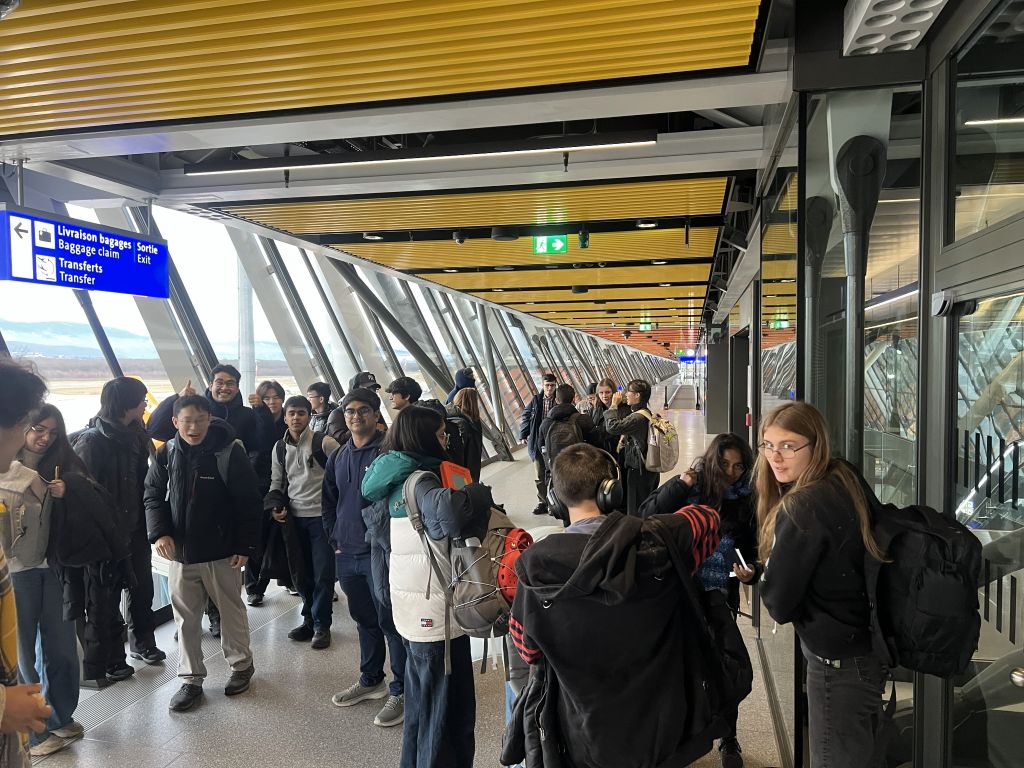
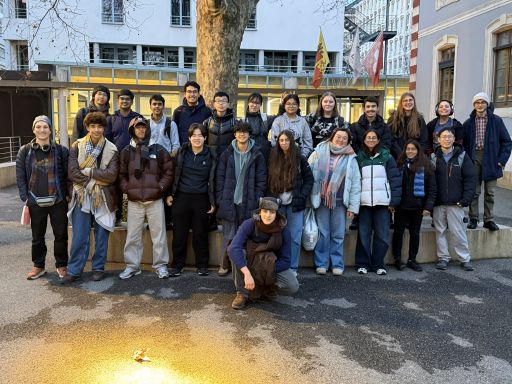
On the first day, we arrived in Geneva in the early afternoon and settled into our hostel. We were divided evenly between the ‘top’ and ‘bottom’ bunks, with an amazing view of Lake Geneva glowing in the dim streetlights right outside our windows. Over the course of the trip, we quickly became very familiar with Geneva’s tram system, which made getting around the city easy, efficient, and impressively punctual. Later that evening, we took the trams across the city to dinner, which was kindly funded by Imperial. It was delicious Italian food, and we all enjoyed it.
On Day 2, we all got ‘up’ super early and rushed ‘down’ the stairs to watch the sunrise over the lake. I even said to the ‘pinning’ swans, “Stop ‘quark’ing!” We then headed to CERN - the most exciting part of our trip.
At CERN, we explored a wide range of exhibitions explaining particle physics in an interactive and accessible way. We were ‘orbiting’ from exhibition to exhibition and particularly enjoyed activities such as Quantum World, which helped bring abstract ideas to life. My favourite was the synchrotron demonstration, where four of us had to time the magnetic field exactly so that steel ball bearings could orbit correctly, giving us an experience into how particles are accelerated and controlled. We also had a interactive tour of the ALICE detector, which is dedicated to the study of heavy-ion collisions and quark-gluon plasma (the state of matter thought to have existed just after the Big Bang).
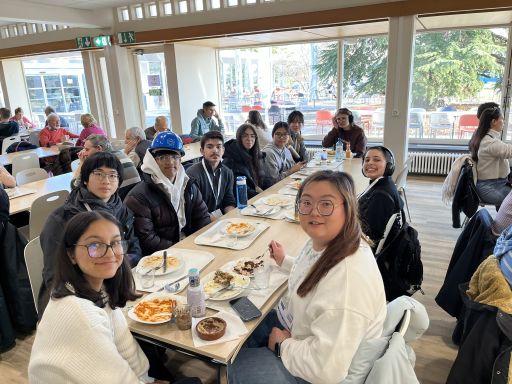 One especially exciting part of the visit was having lunch in the CERN café. Sitting in the same space as working CERN scientists made the experience feel incredibly real, and it was surreal to think that world-changing discoveries might be being discussed at the tables around us.
That evening, we had free time to explore Geneva. Some of us visited the Reformation Wall, learning more about the city’s history, while others explored the streets, shops, and lakeside views. Many people tried Swiss chocolate from local shops (for research purposes, of course), and I was very sad to hear about others trying fondue, especially since I didn’t manage to have any myself! Overall, it was a great chance to experience the city, relax after a busy day of physics, and enjoy time together.
Thank you to Imperial for their support with the trip. Without our connection with Imperial College London, we would not have had the opportunity to visit the CMS (Compact Muon Solenoid) detector on Day 3, making this an especially memorable and exciting part of our experience. CMS is one of the largest and most complex scientific instruments ever built and played a central role in the discovery of the Higgs boson in 2012, alongside the ATLAS detector.
We were also extremely grateful to receive a tour and talk from Dr Benjamin Radburn-Smith, a particle physicist and researcher affiliated with Imperial College London who works on the CMS experiment at CERN. Benjamin spoke to us about his own research and what it is like to work as a physicist at CERN, as well as future developments in particle physics. His research involves the use of artificial intelligence within high-energy physics, which emphasises how modern computing and data science play an increasingly important role in experimental physics. His enthusiasm and openness genuinely helped bring the visit to life, giving us a clearer sense of what a career in physics beyond school and university could look like.
Thanks to Imperial’s generosity and support, we were able to see cutting-edge research firsthand and gain a deeper understanding of the significance of discoveries that we typically only come across in textbooks. For many of us, this experience was genuinely inspiring and eye-opening, bringing the physics we study in the classroom to life and helping us imagine ourselves pursuing physics at university and beyond.
We all had a fantastic time on the trip, and we hope you enjoyed the physics jokes. Even if they don’t always land, at least they have potential energy!
Mini Xu and Val Omer
22/01/2026
Year 13 students